Update, 9/25/2025: Recruitment for this study has ended, thank you to all who participated!
Original Post, 8/13/2025:
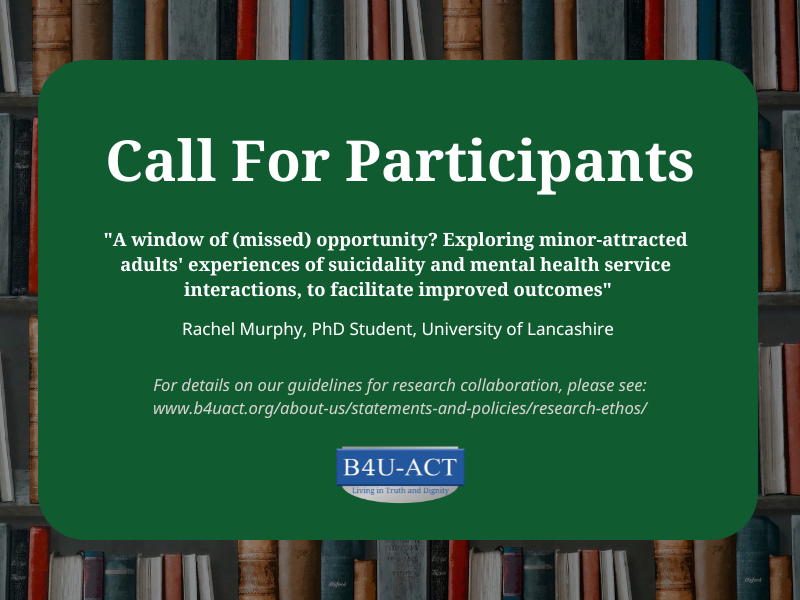
Participants are needed for a new study conducted by researchers at the University of Lancashire in the United Kingdom. The study aims to explore lived experiences of people who are attracted to children who have experienced suicidal thoughts and their interactions with mental health services, to improve and make these services more accessible.
Participation involves completing a 60-minute interview. People who are age 18 or older, who are attracted to children, have experienced suicidal thoughts may be eligible to participate. Participants from the United Kingdom are being sought primarily. Interested potential participants may contact the researcher at rmurphy7@uclan.ac.uk.
The following message was provided by the researcher:
Hello,
My name is Rachel and I am a practitioner researcher. I work in a mental health service in
the UK and am completing a PhD study to explore how mental health services can become
more receptive and responsive to meet the needs of Minor Attracted Persons (MAPs).I am currently recruiting participants to take part in research interviews. I am seeking to
interview people aged 18 or over, who are attracted to children and who have experienced
suicidal thoughts. This is aimed at people who are not currently in the criminal justice
system and who have experienced suicidal thoughts without having committed an offence
involving a child. Participants from the UK are being sought primarily, although international
participants are also welcomed.The interviews will last approximately 60 minutes. They will explore your mental health
experiences, any mental health service interactions that you have had (positive or negative),
and the interplay between your sexual attraction, mental health needs and risk of suicide. If
you have experienced suicidal thoughts but have never accessed mental health services,
you are welcome to participate.The aim is to capture your perspectives and lived experiences, to understand how the
interface between MAPs and mental health services can be developed, to enable more
effective and accessible support services for MAPs.Interviews can be conducted via telephone or online. Microsoft Teams is the suggested
online platform, where you can disable your camera and you do not need to register for an
account; you can be sent the link to join so that you can remain anonymous if you wish.Alternative online platforms can be used, if you prefer. If you wish to remain anonymous,
please set up a non-identifiable email address to use for all correspondence. This will also
allow me to send you the interview link via Teams (or your preferred option) for you to join
without the need to set up an account or provide any identifying information. You are
welcome to use a pseudonym (a different name) throughout your involvement in the study,
and all data will be completely anonymised after collection.If you would like to take part, have any questions, or would like more information please
email me at rmurphy7@uclan.ac.ukThank you for taking the time to read this.
Rachel