[vc_row][vc_column][vc_column_text]Today, Mike Melsheimer, who founded B4U-ACT along with board chair Russell Dick in 2003, would have been 80 years old. Mike was born August 21, 1942 in Jacksonville, FL, the son of the late Richard L. and Nancy R. Ison Melsheimer. He spent his career working in the social services sector. In 1993, he moved to Maryland to seek mental health services from Dr. Fred Berlin in his effort to live authentically and productively as an “out” MAP. Through his volunteer work at a state psychiatric hospital, he met Russell Dick, then a social worker at the hospital, who went on to become the Director of Social Work.

As the two of them became close friends, they became convinced of the need for a non-profit organization to promote the understanding and humane treatment of minor-attracted people within the mental health field. In 2002, Mike launched a one-man campaign which incessantly challenged the Maryland Mental Hygiene Administration (as it was called at that time) to identify a single mental health practitioner or agency in the state that publicly advertised services for “persons like myself” before they broke the law. His dogged persistence resulted in a small annual grant from the state to establish and maintain B4U-ACT, develop a hotline to connect MAPs with therapists in Maryland, and sponsor workshops for practitioners. Mike also successfully procured from the IRS the 501(c)3 status for the organization.

Mike’s advocacy work was not limited to MAPs. His volunteer work at the Maryland state psychiatric hospital involved championing the rights of the patients there. He also received local media coverage for calling public attention to safety issues at the low-income housing complex for senior citizens in which he lived.

After serving as Director of Operations for B4U-ACT for seven years, Mike’s deteriorating health forced him to step down, but he continued to influence the organization’s vision and direction by participating in its events as much as he could. On July 15, 2010, Mike died peacefully after battling emphysema for several years.

[/vc_column_text][/vc_column][/vc_row]

As terms like “minor-attracted person” or “MAP” have become more common among researchers, mental health professionals, and abuse prevention organizations, they have also become more contentious in the public discourse. In particular, conservative commentators such as Laura Ingraham and Tucker Carlson have voiced their disapproval of this terminology, while attempting to associate it with the political left, including LGBTQ+ rights movements.

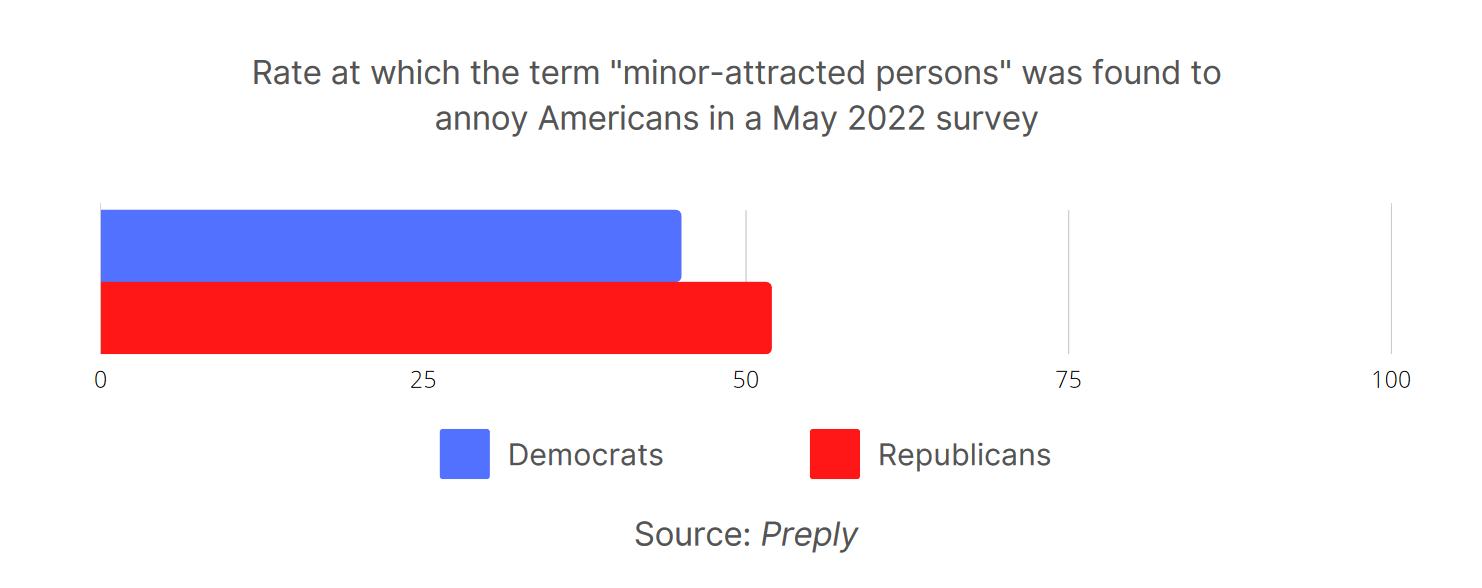
However, according to survey results published this summer by the language learning website Preply, public opinion on this terminology is a near even split, regardless of political affiliation. According to Preply’s article on the results, only 45% of Democrats and 52% of Republicans indicated that the term “annoy[ed] them in practice.” The results are based on a survey of 1,012 Americans conducted in May 2022.

These results differed from other terms in Preply’s category of political or social justice terminology, which tended to be more tolerated by Democrats and less tolerated by Republicans.

Rate at which the term "minor-attracted persons was found to annoy Americans in a May 2022 survey.
A bar chart showing: Democrats: 45%, Republicans: 52%.
Source: Preply

Terms like “minor-attracted person” have the advantage of being more value-neutral than alternatives like “pedophile” or “hebephile,” as “pedophilia” carries strongly negative connotations and is often used incorrectly to refer to child sexual abuse. These negative associations can lead to real-world consequences: for example, a 2021 study found that students planning to become social workers were more likely to break client confidentiality and less willing to work with a client described as a “pedophile” than a client described as someone who is “sexually attracted to children, [who has not] committed an offence against a child.” The study authors went on to use the term “minor-attracted people” in their publication.

Additionally, some academic sources fail to distinguish between “pedophilia” and the condition of “pedophilic disorder” as described in the DSM-5, which requires additional factors beyond attraction to children or adolescents to be diagnosed. This confusion can lead to conclusions that are difficult to interpret, or applied to the wrong group of people entirely.

B4U-ACT has preferentially used the term “minor-attracted person” to refer to people who are attracted to children or adolescents since at least 2007. Before that, we had used the term “minor-attracted adults” for this purpose since our founding, before switching to reflect the fact that minor-attracted people usually begin to experience this pattern of attraction before they are adults.

While many researchers now use terms like “minor-attracted person” and “minor-attraction,” others still refer to “pedophilia,” and some have argued in favor of other alternatives, such as “child-attracted persons.” (See Michael Seto’s response to our review of his 2018 AASECT Plenary Talk)

Preply did not immediately respond to a request for more information about their survey.

Participation in this study has now closed. Thank you to all who participated and supported this research!


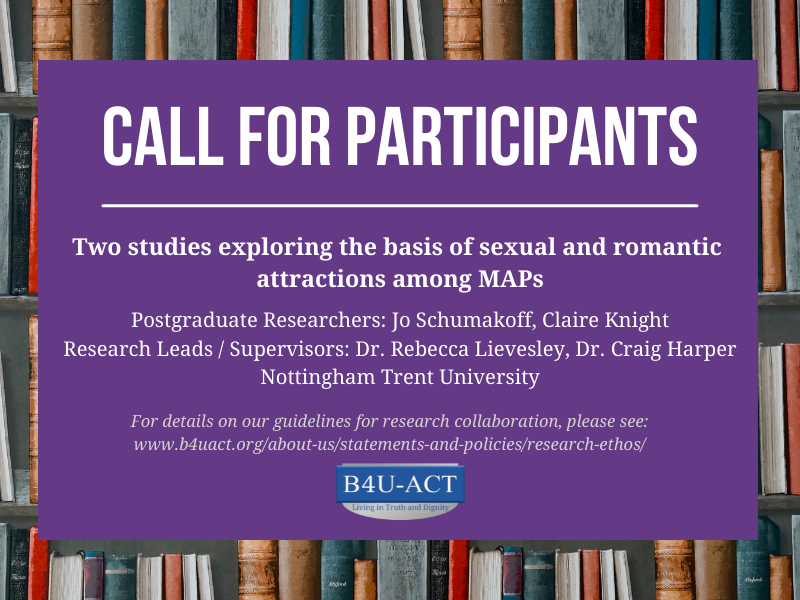
Minor-attracted people are being asked to participate in research being led by Dr. Rebecca Lievesley and Dr. Craig Harper at Nottingham Trent University. Anyone over the age of 18 who self-identifies sexual and/or romantic attractions to children is eligible to take part.

The research includes two separate surveys. Potential participants can use the links below to participate:

The following additional information about the two surveys was provided by Dr. Craig Harper:


Survey 1

This survey explores the sexual and romantic attraction patterns of MAPs in relation to different age categories. With this work we will be looking at whether different features are associated with attractions to children at different stages of development. You will be asked about attraction levels to different groups, and whether different aspects of those groups contribute to feelings of attraction. We anticipate that the survey will take around 15 minutes to complete.

The survey is anonymous, it does not ask for any identifiable information, it does not collect IP addresses and it can be accessed using a Tor browser. The link to the survey is below – the first page provides full information about the study and you can then choose whether or not to take part. If you have any questions please email the study lead on Rebecca.Lievesley@ntu.ac.uk. Please feel free to share or post elsewhere.

https://www.soscisurvey.de/sr_attraction/

Survey 2

This survey contains a picture rating task, where you will be asked to rate the attractiveness of a range of pictures of adults and children in swimwear. 28 pictures will be presented to you. This work will help us to explore how different physical characteristics influence attraction, and this survey is also being completed by people who are not attracted to children so that we can look at scores across different groups. We anticipate that the survey will take around 15 minutes to complete.

The survey is anonymous, it does not ask for any identifiable information, it does not collect IP addresses and it can be accessed using a Tor browser. The link to the survey is below – the first page provides full information about the study and you can then choose whether or not to take part. If you have any questions please email the study lead on Rebecca.Lievesley@ntu.ac.uk. Please feel free to share or post elsewhere.

https://www.soscisurvey.de/sr_attraction/?q=attract_pics